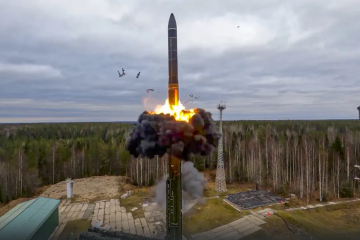
On February 5, 2026, the world officially entered a new era of nuclear uncertainty. The New Strategic Arms Reduction Treaty (New START) has expired, leaving the nuclear arsenals of the United States and Russia unconstrained by any legal obligations.
As Hvylya reports, the BBC has analyzed the situation.
Signed in 2010 and extended for another five years in 2021, the document established strict limits: no more than 800 nuclear launchers (with only 700 deployed) and no more than 1,550 warheads. Crucially, the treaty provided for regular inspections and data exchanges, fostering an atmosphere of transparency and a degree of trust between the two nuclear giants.
Even amidst the relationship crisis following 2014, the parties continued to cooperate under the framework of New START. While each side harbored grievances, they made compromises. Now, the situation has changed drastically—nations have ceased making concessions, and the treaty has simply ceased to exist.
Putin's Proposal Falls Flat
The situation had been heating up for some time. Back in the fall of 2025, Vladimir Putin attempted to play the "peacemaker" card by offering to extend adherence to the limits for one year. However, there was a catch: Moscow flatly refused to restore inspections—the key instrument of mutual verification. Without inspections, any promises from the Kremlin are not worth the paper they are written on.
The White House response was pragmatic and harsh. Donald Trump, having returned to the Oval Office, made it clear that he had no interest in old deals.
"Expiring means expiring. We'll make a better deal," the American leader stated in January, effectively killing off the old format of relations.
Chronicle of Collapse
The disintegration of the treaty did not begin yesterday. First, the COVID-19 pandemic put inspections on pause, and then Russia began using this as a pretext to drag out the process. Following the full-scale invasion of Ukraine, the masks came off: in August 2022, Moscow completely closed its facilities to Americans, and in 2023, it suspended its participation in the treaty, accusing the US of escalation.
Each side has its list of grievances. The Kremlin is unhappy that the nuclear potentials of Britain and France (NATO members) are not included in the overall count. Trump, mirroring his first term, insists that any serious treaty must include China, which is rapidly building up its power.
Arms Race 2.0: "Golden Dome" and "Oreshnik"
While diplomats exchanged notes, military factories were working around the clock. Experts warn: the world has not simply returned to the Cold War era; it has stepped into a far more dangerous phase.
- Russia's Threat: The Kremlin is betting on "wonder weapons" that fell outside New START restrictions. This includes the much-discussed "Poseidon" and the nuclear-powered "Burevestnik" missile. Of particular concern is the "Oreshnik" ballistic missile, which Russia has already used against Ukraine, demonstrating the capabilities of its new medium-range systems.
- The US Response: America is not sitting idly by. Donald Trump has announced an ambitious missile defense project, the "Golden Dome," designed to shield the US skies. The Pentagon is requesting astronomical sums—about $60 billion for 2026 alone—to modernize the nuclear triad. The total price tag for the decade is approaching one trillion dollars.
What's Next?
Analysts' forecasts are grim. Maxim Starchak of Queen's University is certain: control has been zeroed out, and we face a quantitative growth of deadly arsenals in the coming years.
"The end of New START is merely the final period in the destruction of arms control, which has been crumbling for a long time. Control is zeroed out. I suspect that for some time there will be growth in both nuclear weapons and strategic systems in general. Until the elites change, I see no prospects for concluding similar agreements," the expert notes.
Moreover, the specter of resumed nuclear testing hangs in the air. Trump has already hinted at such a possibility, and legally, no de facto ban exists. The world is entering an era where security hinges not on treaties, but solely on the fear of mutual destruction—only now at hypersonic speeds.
We previously reported that a plan to protect Ukraine from future Russian aggression has been revealed.