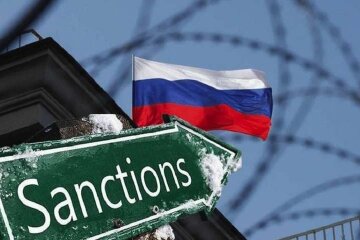
Sanctions pressure on the Russian economy has reached a critical level, and the situation could become "unsustainable" as early as this year.
As reported by Hvylya, this assessment was made by David O'Sullivan, the EU Special Envoy for the Implementation of Sanctions, in an interview with The Guardian.
He detailed how Western restrictions are slowly but surely undermining the Kremlin's ability to fund its war against Ukraine.
According to the Irish diplomat, a veteran with over 40 years of experience in EU institutions, sanctions are indeed having a "significant impact" on Russia’s economy. O'Sullivan emphasized that while sanctions are not a "magic wand" and attempts to evade them persist, four years of enforcement have proven their effectiveness.
"I am reasonably optimistic. The sanctions have really bitten in the Russian economy," the envoy stated. "We may be getting to the point during 2026 where this whole system becomes unsustainable because so much of the economy has been distorted to build up military production at the expense of the civilian sector. I think you can only defy the laws of economic gravity for a certain amount of time."
The interview took place against the backdrop of intense Russian attacks on Ukraine’s energy infrastructure during a harsh winter, with temperatures in Kyiv plunging to minus 20 degrees Celsius. Ukrainian partners informed O'Sullivan that last month Russia launched twice as many drones and missiles compared to January 2025.
However, Putin's war machine is exacting a heavy toll on the broader economy. The Russian economy is facing its greatest strain since the war began: oil revenues are plummeting, inflation has reached approximately 6%, and interest rates have surged to 16%.
Since the full-scale invasion in February 2022, the EU has imposed an unprecedented 19 sanctions packages, targeting over 2,700 individuals and entities and freezing trade across vast economic sectors—from energy and aviation to IT, luxury goods, diamonds, and gold.
O'Sullivan, appointed as Special Envoy in December 2022, noted progress in combatting sanctions evasion. The EU has managed to prevent the direct re-export of critical weapons components via Central Asia, the Caucasus, Turkey, Serbia, the UAE, and "to a lesser extent" Malaysia. He attributed most circumvention schemes to "economic operators seeing an opportunity to make money" rather than government actions.
However, China and its "no limits" partnership with Moscow remain an exception. "China is clearly backfilling and giving support to Russia," though not through direct shipments of military hardware, the diplomat noted. Several EU leaders have raised the issue in Beijing, but the response is invariable: "Nothing to see here. We don’t understand what you are talking about. We don’t see any problem."
Significant success has been achieved in targeting Russia’s "shadow fleet"—aging tankers with opaque ownership structures transporting Russian oil to Chinese and Indian markets. As of December, nearly 600 vessels were under EU sanctions.
"We’ve managed to get flag states to de-flag sanctioned vessels. I think we have significantly tightened the screws on that form of circumvention. Russia is struggling to keep the oil flowing," O'Sullivan emphasized.
The figures speak for themselves: Russia's federal budget revenues from oil and gas—the backbone of its economy—halved in January, dropping to their lowest level since July 2020, according to the Russian Ministry of Finance.
Nevertheless, the EU faces criticism from the US for insufficient severity. Over the weekend, US Treasury Secretary Scott Bessent accused the EU of "funding a war against itself" after the bloc signed a trade agreement with India that excluded additional sanctions on Russian oil purchases. Since the full-scale invasion began, India has become the world's first or second-largest buyer of Russian crude, purchasing it at significant discounts due to Western sanctions.
O'Sullivan defended the deal with India, pointing to prior measures: EU sanctions against a major Indian refinery, a ban on imports of petroleum products made from Russian crude (including those from India), and the decision by the Adani Group, which owns 14 Indian ports, to block access for sanctioned tankers.
"India is a hugely important country and I think we get much more from engaging with them even if we don’t always agree with every position of Indian foreign policy," he noted.
O'Sullivan's team is particularly focused on 300 items on the "Common High Priority List"—critical products that do not typically fall under dual-use export licensing. Items such as memory cards, optical readers, and printed circuit boards from European companies have been recovered from Russian drones, missiles, and helicopters.
"There has been a huge increase in awareness among member states about the potential for selling western technology to foreign distributors who then supply on to Russia. I don’t think we have completely eliminated it, but I think we have reduced it," O'Sullivan said.
"If you go to Kyiv to the Institute of Forensic Expertise, you can see from the breakdown of the debris where the components come from, and unfortunately, they are mostly from western countries—the US, the EU, Switzerland, or the UK. That is shameful for all of us," the Special Envoy admitted.
Previously, the EU announced a new sanctions package against Russia.