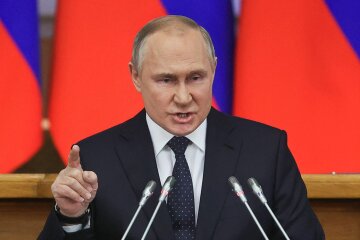
Robert Kaplan, author of "Waste Land" and one of America's leading geopolitical thinkers, has offered a paradox at the heart of Russian power: Putin has committed what Kaplan called "a great blunder" with his war in Ukraine, yet "nobody could replace him, perhaps because nobody wants his job."
As "Hvylya" reports, Kaplan shared this assessment in an interview with Ryan Murdock while discussing the institutional fragility of great powers.
The problem, Kaplan explained, is structural. Putin does not govern through functioning state institutions. He rules through "concentric circles of oligarchs and crime figures and intelligence figures." This system works only as long as its center holds - and Putin is the center. Remove him, and there is no mechanism for orderly transition.
Kaplan contrasted this with China, where strong institutions - a standing committee, established procedures - would allow governance to continue even without Xi Jinping. Russia has never had that luxury. "Russia has always been weakly institutionalized throughout its history," Kaplan noted. "Even the czars had very little control of what went on in the hinterlands." We previously reported on economist Ustenko's detailed study of Russia's structural vulnerabilities - reaching similar conclusions about the fragility of the system.
The war in Ukraine has only deepened this trap. As the conflict drains Russia's capacity to project power across the Caucasus, Central Asia, Siberia, and the Far East, the system grows more dependent on Putin personally - even as Putin's blunder makes succession more necessary. When he eventually goes, Kaplan warned, Russia could face a "low-calorie version of the former Yugoslavia." As this year's Munich Security Conference made clear, the West is already living in a "state of disruption" - and a chaotic Russian transition would only deepen the crisis.