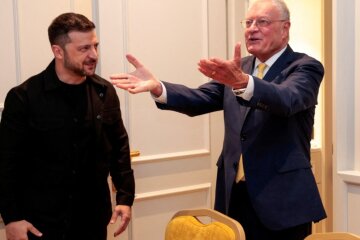
President Trump promised to end the war on day one. Thirteen months later, the war grinds into its fifth year, and his own former envoy is publicly breaking with the administration's approach. In a remarkably candid interview with PBS, retired Lt. Gen. Keith Kellogg — who served as Trump's special envoy to Ukraine until December 2025 — reveals what happened inside the Oval Office when the Zelensky meeting collapsed, why he believes Putin is trapped but dangerous, and why treating the war as a business deal is a strategic mistake. His message is blunt: the US has the cards to end this war, but isn't playing them.
Nick Schifrin: War and peace. Russia's full-scale invasion enters its fifth year. The war is a brutal, bloody stalemate, and diplomacy appears deadlocked. Tonight, President Trump's recent envoy to Ukraine takes us inside the administration's strategy for ending the war. Explains how we got here, and what's ahead. Coming up, on Compass Points.
Nick Schifrin: Hello, and welcome to Compass Points. President Trump famously said on the campaign trail that he would end Russia's war against Ukraine on day one of his return to the White House. Today, the president is thirteen months into his second term, and the war is starting its fifth year. Ukraine is enduring a relentless bombardment, including against its power system during a bitterly cold winter, and civilian casualties are at an all-time high. Here tonight to give us an inside look at the state of the conflict and the negotiations to try and end it is retired Lieutenant General Keith Kellogg. He was President Trump's special envoy to Ukraine until the end of last year, and he is now co-chair of American Security at the America First Policy Institute. General Kellogg, thanks very much. Welcome to Compass Points.
Keith Kellogg: Thank you. It is good to be here.
Nick Schifrin: Appreciate it. You often argue that Russia is not winning in Ukraine, and you recently said that Russian President Vladimir Putin is looking for a way out but he can't psychologically get there. Why do you think Putin is looking for a way out, and what could that look like?
Keith Kellogg: Well, I think when you look at just the sheer numbers alone. First of all, when I say he can't get his way out of it - he is not winning. And what I mean by not winning is, he has really never gone beyond the land he has got right now. He hasn't crossed the Dnieper River.
Nick Schifrin: The river that divides Ukraine, basically.
Keith Kellogg: He hasn't got to Kyiv. He has added two new NATO members, both in Finland and Sweden, which - they are pretty good. So his definition of winning is not mine. Now, and I use this as a data point. When the Soviet Union left Afghanistan, they left after losing eighteen thousand. He has suffered between 1.2 and 1.4 million casualties, dead and wounded. So I think he has got himself a problem where he can't really get out based on the losses he has taken, the equipment he has taken, and he has driven himself to be a regional power, not a full power. So I think he doesn't want to become a Nicholas II, the last Czar of Russia, where somebody shoots him. But I think he is worried about the fact that he has had those losses. The people haven't turned on him yet. But if you keep sustaining losses like that, eventually you are going to move into the area which we call White Russia, which is west of the Urals, and then the people are going to start saying, "What is going on here?" And you start to see the military bloggers right now saying, "What is going on? What is our strategy?" And I think they have reached a point after four years of war where their frontline units have been mauled. They don't have the military capacity to be able to continue the offensive beyond where they have gone. And it is sort of like a trap. And he is going to say, "Well, I have got to get a victory. If I don't get a victory, somebody is going to probably try to eliminate me."
Nick Schifrin: There is, of course, the question of how to deal with him, though. I mean, he is ultimately the single decider when it comes to Russia. He is in negotiations with the United States right now. The lead negotiator for President Trump, Steve Witkoff, recently said this about Putin on Fox News.
(Steve Witkoff: "He has never been anything other than straight with me. And I say that, and I get attacked. But that is an accurate statement.")
Nick Schifrin: "Never been anything other than straight with me." Is that your assessment of Vladimir Putin?
Keith Kellogg: Well, here is my assessment of Vladimir Putin. As long as you realize that President Putin was a KGB colonel. The furthest west he was ever, other than like trips to Alaska, was stationed, was Dresden, Germany. And you just have to understand the personality and the understanding of Slavic and the Russian personality. And then kind of say, do you really trust a guy like that? I keep going back, let's say back to 1938, when Neville Chamberlain said he trusted Hitler. Well, history proved that not to be good. And so the question is, do you really trust a guy like that? And circle around him. So I think you have to have healthy skepticism about what his objectives are. And any KGB agent, a good one, would probably tell you one thing and mean something else.
Nick Schifrin: There is a bottom-line question, of course, whether Vladimir Putin is even willing to negotiate or willing to agree to some kind of peace deal. Two senior European intelligence officials told reporters at the Munich Security Conference a couple weeks ago that Putin is not negotiating in good faith. Do you agree? Is there a deal that Putin would even agree to?
Keith Kellogg: Yeah, I think right now - if I was advising him, just declare victory and go home. Because you are not going to give up the land you have got. But the reason why he wants that part of the Donbas, Donetsk province -
Nick Schifrin: In eastern Ukraine, right.
Keith Kellogg: - is, you look at the three fortified cities that are still left, the defensible terrain. And I have walked that terrain. I have been on it. And it is really the last piece of really defensible terrain before Kharkiv, which is the second city.
Nick Schifrin: Second largest city in Ukraine.
Keith Kellogg: And then that gets you to Kyiv. So if you are willing to accept the fact that he is a Jeffersonian Democrat and that this is as far as he is going to go, okay. But history has shown that in real politics, he has probably got a desire to conquer, or at least get to Kyiv, or make them neutralize them to such a degree that it is kind of like Kissinger used to want to have basically a neutral power. And I really - people don't understand the size, I think, not only of the war, which is the largest war in Europe since World War II, but Ukraine is a huge country. At the end of this, the Ukrainians want to have an army of eight hundred thousand. Think about that. No army in Europe is that large. None.
Nick Schifrin: Or as battle-tested.
Keith Kellogg: Or as battle-tested. So the new axis for the West will probably stretch through Poland and Ukraine and down into Romania, as opposed to where it used to be, which is the Baltics, the German countries, and France.
Nick Schifrin: So if your assessment is that Putin still wants to subjugate Ukraine, essentially, and that is the main goal - a certain assessment shared by the Europeans I talk to, many Americans I talk to - you keep talking in public about how Putin is the impediment to progress. But here is what President Trump said about this on February 13th.
(Donald Trump: "Russia wants to make a deal, and Zelensky is going to have to get moving. Otherwise, he is going to miss a great opportunity. He has to move.")
Nick Schifrin: What should we understand about why, at least it seems to a lot of people, President Trump continues to pressure or blame Zelensky and not Vladimir Putin?
Keith Kellogg: Well, I won't speak for the president. But when you look at it, the overtures that have been brought back to him are business-related, where you have got Kirill Dmitriev.
Nick Schifrin: Head of the Russian sovereign wealth fund, yeah.
Keith Kellogg: And when he starts talking like trillions of dollars are available, which I don't believe, and that kind of sways you to where you are thinking, and Steve being a businessman kind of looks at it like that. I take a different approach. I look at the guy, what he really is - he, meaning Putin - where he came from, and that I think he does have ulterior motives. He just can't realize them. And I think if you come from that perspective, that is where the Europeans come from, is that do we really want to take a chance on this guy. And I think most of them don't. I was just in Cambridge, UK last week. They are not willing to go there. And I don't want to see World War III start. I don't want to see my grandchildren involved in that. And we have made mistakes in the past. And I would prefer to err on the side of caution with Putin and just say, you are going to go as far as you went, this is where you are going to be, take it and go home.
Nick Schifrin: You mentioned business deals. I want to bring up a post that you had on X. So this week the US declined to support a UN General Assembly resolution supporting, quote, lasting peace in Ukraine. The US chose to abstain. And in response you wrote this: "Is not four years of war enough? Is not missing children, shelling of cities, and the killing of innocents enough? It is not a business deal. It is war." Why did you write that?
Keith Kellogg: Well, I believe that. I mean, being a former soldier, you don't approach this fight as just a business deal. It is a war. They have invested a lot out there. You have got to understand the terrain that is on the ground. And when I was talking about the UN resolution that was passed, it was really a simple resolution. It was stop the war.
Nick Schifrin: In the General Assembly, no less. No legal binding at all.
Keith Kellogg: Yeah. And return the children. We have got thousands of children. That sounds like a pretty good idea to me. Bring the children back, stop the war. And so that is the reason it was there. And that is the reason I said that.
Nick Schifrin: But are you saying that the US team is now approaching this as a business deal rather than -
Keith Kellogg: I think they always have. I think that is an error. If you approach it that way, there is always an economic aspect to it. And I think what they have to do is understand it is a game of wills. This actually goes back to basically 1958 when there were books written about real politics, and real hard, realistic politics. And I think that is where we are at today. I think we are back to spheres of influence, and our sphere is currently, the primary one, is Latin America.
Nick Schifrin: But when you say that is an error, what is the impact of that error? What is the impact of approaching these talks in that way rather than the way that you would?
Keith Kellogg: Well, I think you operate, as any nation should, from strength. And we are a really good nation. To me, when you look at the United States, there is one primacy - the United States. And there is no really second. And there is a third, fourth, fifth, and sixth. And I think we operate from that aspect, that there is no other power on earth that is as strong as we are. And play your strength. It is sort of like an American poker game. If you go all in, the other side doesn't know - do you really have the cards or not? And I think we, the United States, have got the cards to force Putin to say, time for you to go home. Time to call it a day. Time to end this war. Putin is not going to win this war. I don't think he has got the wherewithal to do so. He doesn't have what I would term the legs, the combat power to go much further. It is a depleted military. Economically, he is being hammered. It is a petro-state. When you look at Urals oil, it is now trading at forty dollars a barrel.
Nick Schifrin: Yeah.
Keith Kellogg: Where I think Brent is being traded, which is the benchmark, at seventy dollars a barrel. It is a real problem for him.
Nick Schifrin: You use the word "cards," and I have to - I am reminded of a moment last year that I have to ask you about. So, like I said, you were in this position until December 31st. And on February 28th, 2025, the Oval Office hosted a moment that has become so infamous, the word "Zelenskyed" has really become a warning to other foreign officials who are visiting President Trump. Let us take a look.
(Volodymyr Zelensky: During the war, everybody has problems. Even you. But you have nice ocean, and don't feel now. But you will feel it in the future. God bless. God bless).
(Donald Trump: You don't know that. You don't know that. Don't tell us what we are going to feel. You are not in a good position. You don't have the cards right now. With us you start having cards. But right now you don't. You are playing cards. You are playing cards. You are gambling with the lives of millions of people. You are gambling with World War III. You are gambling with World War III).
Nick Schifrin: It is hard to even watch today. And this is you in the corner right there, highlighted, in the Oval Office that day. What was going through your mind?
Keith Kellogg: Well, we had met with Zelensky that morning. And I had told him a couple things. One is, don't make it a controversial or contentious meeting. The second, I said, "Sir, I know you like to use English and speak English. Use your interpreter." He goes, "Why?" I said, "Because it allows you to think before you answer the question." And he said something that was really telling right there, that confirmed what I said. He interpreted, when President Trump said "you don't have the cards," he thought it was a card game. That is not what he was getting at. So it didn't allow time for you to think your way through what you were going to say.
Nick Schifrin: And Ukrainians told me afterward, he said "God willing" - he meant "God forbid." And he just didn't know the translation quite right.
Keith Kellogg: That is where I said, and I have told him that more than once, use your translator as an advantage. English is not your primary language. It is like your third or fourth language. And to me that is good advice. He didn't follow virtually any of the advice. Later that week, I went to the Council on Foreign Relations and I said, "Well, sometimes you need to beat a head like a mule with a two-by-four." And it was almost like he got in over his skis. And it was painful to watch, because everything we had told him to do, he didn't do.
Nick Schifrin: Because it seems to me that you wanted him to succeed. You wanted him to sign the minerals deal that he was supposed to that day. You wanted him to present himself to the president as how you saw him. I mean, just the week before that Oval Office meeting, you went to Kyiv, you saw Zelensky in his office. We see it right here. And after this meeting, you called Zelensky a, quote, "embattled and courageous leader." But what reaction did that statement get from the White House?
Keith Kellogg: Not a very good one. And let me explain why. And it is interesting, because I have said to people that he is embattled. He has been fighting for a long time. He is courageous. And courageous - define it. The day of the invasion he said, "You will see our face," to the Russians. "You will see our face, not our back." And he was offered a ride to get out of town. He said, "I don't need a ride, I need ammunition." Is that man courageous? Sure is. When you talk about embattled, I said, here is a guy whose country is at war, with an existential fight for his freedom. I said, the last time an American president faced that was Abraham Lincoln. And I said, we have to understand where he is at and where he has come from. He hasn't left town. He is willing to fight. He is willing to do things. And I had this whole discussion with him. And what you didn't see there - that was the press was in the room.
Nick Schifrin: There, you are talking about in the Oval Office.
Keith Kellogg: Right. Before that, in the meeting, there was a bilateral, meaning no press. It went really well. And then the press came in, and it all started, probably with questions from the Vice President. And there was a reporter to my right saying, "Why didn't he wear a suit?" Who cares. That was his national dress. He is wearing it. He came in, later the next time he came here he wore a suit. And I think the tension started to rise. And I would have said, don't fall for it.
Nick Schifrin: What you didn't see there was that he ran everybody out of that office when you first met. It was just he and you?
Keith Kellogg: They came in with us, his team did, and he ran everybody out of that office when we first met. It was just he and I. And we spent a considerable amount of time in there. I know he was tired. You look at his face, and things like that age you.
Nick Schifrin: When you said that the White House didn't give you a positive response - who doesn't want to, or who didn't want to see him as a courageous leader?
Keith Kellogg: Well, I think there were people in positions of authority that kind of said, "Well, you are kind of calling him out, saying this is an individual where we were skeptical about." And I said, "No, I am just being very honest. I would have said it to Sam Smith the same way." Because I think what you have to understand is you reset the stage. You reset the equation. And grudgingly, you get a guy like that involved and you get him and draw him out and you talk to him.
Nick Schifrin: But that skepticism of him seems to have played out in real-world life-and-death consequences. January 26th, right before that meeting, a US official told me the Pentagon had issued an order to stop weapons being drawn down, as it was during the Biden administration, and sent to Ukraine. And then I was told stoppages and slowdowns occurred again, whether from the Department of Defense or the White House. March, July, later that month. Some of these were stopped within hours or days, including by you and your team. But overall, what was the impact of all of that skepticism, all of that questioning of Ukraine, Zelensky, and the entire effort?
Keith Kellogg: Yeah. I think, in self-serving - meaning we look to the United States. And I have to explain. I said, look, first of all, you have to understand stockage levels of war. And for example, let us just use the PAC-3 missile.
Nick Schifrin: Patriot missiles, the most advanced air defense that we have.
Keith Kellogg: So, Lockheed Martin is the prime producer of the Patriot missile. But people don't realize the seeker heads, the PAC-3 seeker-head missile, is made by Boeing. And they only make thirty of those a month. They shoot those in a day. And it is our own fault, meaning the United States' fault. Because years in the seventies, we had what we used to call a 2.5 war strategy. You could fight a war in the Pacific, one in the Atlantic, and also a .5 left over. We drew that down to 1.0. Because of that, the stockage levels went down. And companies weren't on a wartime footing. So we have to make sure we protect ourselves. And the president did that - when they metered it out, they questioned what it was going to take, went back to the unified commanders, the centralized commanders out there. What do you need to prosecute a war plan? And I think we were saying we are running out of these. We are running out of - for example, let's use the Javelin anti-tank missiles. People don't realize that assembly line is dead. It is gone. So they had to resurrect the Javelin assembly line. So we have to protect ourselves.
Nick Schifrin: So you are acknowledging the arguments that everybody heard on all sides for years, right? We only have so much capacity, in terms of missiles, especially air defense, anti-tank, so that we do need to reserve them whether for the Middle East or Asia, not send them to Ukraine. But the other side of this is how to pressure Russia, right? How to get back to that peace table that I think everybody wants. And you said something interesting in Kyiv a few months ago. Recently, you said, to solve the war, you are probably going to have to raise your level of risk. And the example you brought up was Richard Nixon in 1972, on Christmas, bombing North Vietnam in order to try and get a diplomatic deal on the table. So let us talk about pressure moving forward. For example, should the US send Tomahawk missiles to Ukraine?
Keith Kellogg: Well, I think you don't really have to send them because they have come up with alternatives to do that, with what they call the Flamingo missile.
Nick Schifrin: Their own versions.
Keith Kellogg: But I think just the president saying, "We are thinking about doing it," or "Going to do it" - it might change the equation. But I think the real attack line is economic. And we are doing this, by the way, right now - attack the shadow fleet. The shadow fleet carries the illicit oil. And last week when I was in Europe, I said to them, "Look, seventy percent of that comes through the Baltics. You can shut it down if you want to." And so I wouldn't say the military equation will change, but the way that President Putin pays his troops and funds the war is through petro. And when you look at Urals, the price of the barrel of oil going down, then attack that. And we keep talking weaponry - they, the Russians, have a tremendous ability to suffer. And it is sort of like in their culture. These are people who lost millions of people in World War II. And I said, okay, let's attack it differently. And if you attack it economically, like with the sanctions, the sanctions are going with the shadow fleet, you can probably do that.
Nick Schifrin: But can the US go further? I mean, the US has seized Venezuelan tankers, right? The US has seized North Korean tankers. Are you saying that the US could seize Russian shadow fleet tankers?
Keith Kellogg: Well, yeah. Where we sanction them. And by sanctioning them, you can - it allows you to take them. Not us, but the allies as well. And I think that you take that shadow fleet, you take it off the books to do that. It is interesting - the Secretary of Treasury and I were talking, and he said, when you look at sanctions layered one to ten, one being easy, ten being hard, we are probably at a six.
Nick Schifrin: A six in terms of what we have or how we are enforcing?
Keith Kellogg: How we are doing it right now. But he said, enforcing them, we are at a three. So his point was, where do you want to go, what do you want to do. And I think the pressure on the economics is good. For example, Putin pays death benefits - two hundred thousand dollars a soldier. It is enormous. A lot of money. Life-changing for families. And you get a babushka in east of the Urals - that is a whole life. So you cut that out. So that is where economically he has got a problem.
Nick Schifrin: I wonder if you could reflect. You spent more than thirty years in the military, including one of your jobs was as the top Special Operations commander in Europe at the end of the Cold War. This is not quite that old photo, but an old photo of you in uniform.
Keith Kellogg: Almost was, yeah.
Nick Schifrin: And I am told you are fond of saying versions of this statement: "I have tried to kill Russians, and they tried to kill me." Now that you are no longer in the administration, I wonder - is there anyone bringing that perspective?
Keith Kellogg: I don't know. I mean, you would hope there are. You think of people like Secretary Rubio and Steve are doing that as well. And I am sure there are advisors out there. But who is the president listening to? I think you have to have - my comment is, you have to have that person in the room that is willing to tell you, no. I used to have people, when I was in military units, I always found somebody. I said, "I want your main job to be to tell me, once I make a decision, tell me that is the dumbest thing I have ever heard." And they said, "What?" "And then explain to me why I made a mistake."
Nick Schifrin: But does the president want that?
Keith Kellogg: Oh, the president - I will tell you, from knowing him as long as I have, he really is good at that. He has got a Socratic way of doing business. And is there someone doing that for him right now? I don't know. But when I was there, he had the ability to take that. Now, you better be ready to take the blowback. If you are not ready to take the blowback, then you are in the wrong place.
Nick Schifrin: I want to end here by asking you about something you told the Kyiv Independent. You said you were leaving the Trump administration because you wanted to spend more time on the outside, "where I could be much more open and free to talk about Ukraine than I was inside the government." We have been talking for twenty minutes here. What else would you like to say now that perhaps you weren't able to say before?
Keith Kellogg: Well, I think it is more emphasis than saying it, because I have said it. You have to ask yourself a question - is this just a pure business deal, or is this, when you say war, something you need to be aware of so we don't have another World War III? And I don't want my grandkids going to war. And I grew up, maybe I am a product of the seventies and sixties, where you grew up with the Warsaw Pact, you looked at the Soviet Union, and the level of trust - my level of trust isn't very high with them. And I look at the Ukrainian people from being in there, inside, being to Kyiv and being to Kharkiv and being to Izium - you look at what they are willing to go through. And you look at them, you go - I looked at their soldiers. I have been to hospitals. I have talked to soldiers out there. And you just take your hat off to them. For what they have been willing - what they are able to withstand. And I think you just need to say to President Putin, okay, why don't you just call it a day. Call it a day. And just freeze in place, you go home and do it. But I don't know if we have done that to him, or he has been willing -
Nick Schifrin: You mean, you don't know if the US has made that ultimatum.
Keith Kellogg: Yeah. I mean, I would do it. Say, the ultimatum is take it or go home. And then if he doesn't, it is one of those things you could do today. And there is more and more, especially in this last week - the Europeans are taking more of a lead. And if they don't watch out within - if we don't watch out within a year, they are going to go without us.
Nick Schifrin: Lieutenant General Keith Kellogg, thank you very much. Been a pleasure.
Keith Kellogg: Yeah. Thank you.
Nick Schifrin: That is all the time we have for tonight. Thank you at home for joining us. I am Nick Schifrin. We will see you here again next week on Compass Points.