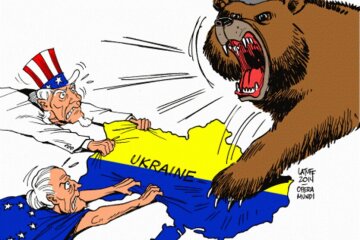
Security guarantees, a plan for Ukraine's post-war reconstruction, the question of Donbas, and a new European security architecture are merely words behind which lies the game of geopolitical players. Therefore, it is crucial for Ukrainians to understand what geopolitical players want to gain and why they need Ukraine.
All talk about providing Ukraine with security guarantees is primarily aimed at creating an argument for Volodymyr Zelensky to "sell" to Ukrainians the necessity of a "territorial compromise" — in effect, the abandonment of their territories. This is precisely how Americans perceive these discussions about security guarantees, as well as talk about a large-scale plan for Ukraine's post-war reconstruction, which is now a simulacrum, since its implementation will be impossible due to our country's location in a "gray" geopolitical zone [buffer].
For Ukraine to receive genuine security guarantees, the critically necessary condition is the deployment of a large number of Western military forces near the line of demarcation and the presence of military bases of the United States, the United Kingdom, France, and Germany on Ukrainian territory. But the elites, as well as the societies of these countries, are absolutely unprepared to implement this scenario, which is why statements about security guarantees are a game aimed at information-political influence.
What security guarantees can we speak of when not a single Western country is ready to become Ukraine's ally and have obligations to defend it? Americans, like many European politicians, are perfectly content with Ukraine serving as a buffer — a resource for geopolitical bargaining with Russia.
For Americans, Russia is currently the key and most important country for maintaining their geopolitical and geo-economic dominance in Europe and preventing the emergence of a Eurasian hegemon. In fact, the very existence of Putin's Russia and the threats emanating from it allow the United States to "milk" Europe; without the existence of the Russian "boogeyman," U.S. influence in Europe and European dependence on America would be much smaller.
American economists estimate U.S. enrichment from Putin's adventure at more than $700 billion through increased exports of American gas, oil, and weapons to Europe. Russia's aggression has also diminished China's influence in Europe for a long period of time, postponing the possibility of creating a Eurasian continental axis between Beijing, Berlin, and Paris.
The end of the war in Ukraine, according to American plans, should lead to a reduction in Russia's economic and technological dependence on China, which will first enable achieving Russian neutrality in the confrontation between Beijing and Washington, and later, over time, transform the Russian Federation into a frontier for containing the Middle Kingdom.
Meanwhile, the strengthening of economic interdependence between Russia and Europe, as representatives of Donald Trump's foreign policy team believe, will allow the United States to simultaneously influence both Russia and Europe, positioning itself as an independent arbiter.
In the understanding of representatives of the American elite, the war between Russia and Ukraine is a conflict of barbarians: if Ukrainians have always been "needed" by the American elite as an instrument for containing Russia, then Russian barbarians, according to American plans, are supposed to contain China. In fact, the role of Russian and Ukrainian barbarians, from the American perspective, is quite similar — to be a U.S. resource for blocking the emergence of a hegemon in Eurasia capable of creating a continental alliance.
Russian bandits, as Americans believe, decided to fight for hegemony without having the resources for it, being merely a regional player, which is why Donald Trump's team is now effectively sending a "signal" to the Kremlin about a new coexistence. The Russian elite, along with the regime, retain full control over Russia and the occupied territories of Ukraine; what will happen in these territories is of absolutely no interest to Washington. In return, Russian bandits must agree to American access to Russian natural resources in exchange for American investments.
As for Ukraine, according to Donald Trump team's plan, it should continue to remain a buffer that will be militarized with European assistance. Thus, this geopolitical game assumes that for Russia there will be a Ukrainian threat, for Europe a Russian one, and after strengthening economic interdependence between the United States and Russia, conditions will be created in the future for transforming the Russian Federation into a frontier for containing China.
Currently, Americans are using sanctions against Russia not to help Ukraine, but to push the Russian Federation out of oil markets, taking advantage of Putin's adventure against Ukraine. It is also important to understand that Donald Trump has de facto allowed Putin to destroy Ukraine's energy infrastructure using terrorist methods of warfare. Donald Trump has never publicly condemned these attacks, demanding Putin stop them, never imposed sanctions after them, and never increased military aid.
Thus, Donald Trump's actions indicate that his de facto permission for Russia to use terrorist methods of warfare against the peaceful Ukrainian population is aimed at creating conditions for Ukraine's exhaustion and the agreement of Ukrainian authorities and society to unfavorable terms for ending the war.
The entire American game can be described by a Ukrainian Russian-language joke: "Godfather, what is the 'Spirit of Anchorage'? It's, my friend, when Americans say that the rape of Ukraine and Russia is love."