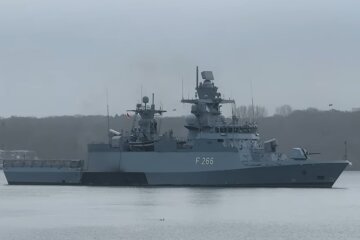
The most atmospheric news came yesterday from Germany.
Law enforcement detained two individuals – citizens of Greece and Romania – on suspicion of committing sabotage on German Navy ships in the port of Hamburg.
From the context, it follows that the perpetrators managed to wreak havoc on at least two corvettes, but the most remarkable (of what was made public) is the vandalism of the corvette Emden.
This is not just any corvette – it's the newest corvette, which only a year ago completed its first long training voyage. Emden is part of a package of 5 corvettes ordered in 2017, which were intended to strengthen Germany's presence in the Baltic.
On one of the ships, they poured 20 kg of abrasive gravel into the engine, damaged the freshwater supply pipes, removed fuel tank caps, and disconnected circuit breakers of onboard electronics. All this nastiness was discovered in mid-January before Emden's departure to sea.
So far, there's no data on why two individuals, acting both jointly and separately, decided to harm the German fleet. One could assume deep personal animosity, but everyone has only one version in mind.
Some German media wrote it outright: "data on the involvement of Russian intelligence services has not yet been disclosed." Because the chain of terrorist attacks and acts of sabotage doesn't leave too many options.
But there's certain confusion with accusations because Russians are not the only suspects.
Taking very recent history, in September 2024, the frigate "Baden-Württemberg" and the supply ship "Frankfurt am Main" passed through the Taiwan Strait during a crossing from South Korea to the Philippines. China then called this gesture a "wrong signal."
And already in December 2024, a Chinese citizen was detained in Kiel on suspicion of espionage against the naval base.
And already in February 2025 (that is, exactly a year ago), some vague reports appeared about an act of sabotage on the aforementioned corvette Emden. As media claimed, perpetrators dumped dozens of kilograms of metal shavings into the propulsion system. Additional cleaning was required before delivery to the fleet.
All this once again actualizes an already worn-out topic – Europe's readiness for real confrontation with adversaries.
Each such report indicates that discussions about the overall defense potential of NATO countries / European countries and comparisons with Russia in the spirit that Europe is richer, more numerous, and technologically ahead are speculative and do not reflect the real situation.
All recent assessments prove that Europe won't manage to deploy even a small part of its potential at the critical moment due to sabotage from within. Armored columns will get stuck on damaged railways still in France or will be burned by cheap FPVs on the way to the eastern flank. As will part of the aviation. Because it's known where it nests.
It is precisely these assessments that lead to the conclusion about the realism of RF attempts to engage in limited military confrontation. Especially if China quietly helps it.
It won't be possible to reach an agreement amicably, because Europe's opponents have already tested active actions and convinced themselves of their effectiveness. They will do this again and again. Such impulses can only be repelled while simultaneously investing in adapting infrastructure to new realities.
Without leveraging Ukraine's potential, this task cannot be solved.
It's also necessary to move from words to deeds in combating RF oil trade through the Baltic. Currently, it's flourishing both in the "shadow fleet" mode and quite "white" European.