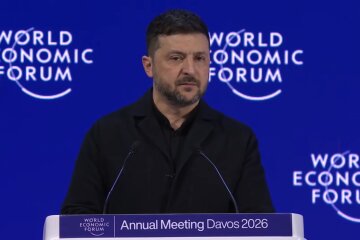
Ukrainian President Zelensky delivered a powerful speech at the Davos forum, sharply criticizing Europe and hinting at its inaction in the face of Russian aggression. He noted that while Europe frequently issues bold statements regarding defense capabilities, Ukraine, and Vladimir Putin, little substantive action follows. Words alone, he argued, cannot build a new world order. Zelensky reminded his audience that Russian energy exports, which fund the Kremlin's war machine, continue to flow freely near European shores. While the U.S. has seized tankers belonging to Russia’s shadow fleet and successfully detained Venezuelan dictator Nicolás Maduro, Putin remains at large.
Zelensky’s remarks drew a mixed reaction from European leaders. Some expressed frustration, suggesting Ukraine fails to appreciate the aid that has kept the country afloat. While that aid is vital, Kyiv has consistently had to plead for it, and deliveries are often insufficient or delayed. For instance, prior to a massive missile strike on Kyiv on January 13, Ukraine lacked enough air defense missiles to intercept the full scale of the attack. They repelled the first wave, but ran out of interceptors for the second. Consequently, millions in Kyiv were left without heat, electricity, or water in −15°C temperatures. Although sufficient missiles arrived days later to repel subsequent attacks, hundreds of thousands of families remain in dire conditions during a brutal winter.
The scale of aid is significant: Europe has provided $180 billion to date, with Brussels pledging another $200 billion over the next two years. However, the cost of inaction would be far higher. Over four years of war, Ukraine has destroyed nearly 36,000 Russian tanks and armored vehicles and neutralized 1.235 million Russian soldiers. Had Ukraine fallen, these forces could have marched to the English Channel, occupying multiple EU nations and inflicting damage measured in trillions, not billions. While hypothetical for now, the withdrawal of most U.S. troops from Europe this year could make such a scenario a reality by 2027.
During the Davos summit, Zelensky met with Donald Trump. Although the Ukrainian president initially stated he would only attend if real agreements were on the table, the American leader publicly urged him to join the summit in Switzerland. Despite this, documents prepared with the U.S. side remained unsigned. These agreements concerned post-war reconstruction and security guarantees. Trump refused to sign, partly due to the unyielding stance of European partners regarding Washington’s request for concessions on Greenland in exchange for supporting Ukraine. Another sticking point was Zelensky’s refusal to cede northern Donetsk, a region currently held by Ukrainian forces. Ceding these strategic heights—a natural shield against Russian advances—would leave neighboring regions vulnerable. As a compromise, Kyiv proposed a Free Economic Zone in Donbas, insisting that any Ukrainian withdrawal must be met by an equal Russian retreat—a condition the Kremlin has rejected.
Donald Trump’s peace philosophy centers on ending the war through Ukrainian territorial concessions in exchange for financial investment and security guarantees. This includes Kyiv relinquishing 20% of the Donetsk region not currently occupied by Russia. In return, Trump promises up to $800 billion in reconstruction investment and Western security guarantees. Essentially, the formula asks Kyiv to trade strategic territory now for the promise of future investment from as-yet-unidentified sources. This presents a harrowing choice: losing the fortifications in northern Donetsk could open the path for Russian troops toward Dnipro, Mykolaiv, and Odesa, potentially cutting off Ukraine’s access to the Black Sea and making its exports critically dependent on Moscow. Furthermore, it leaves the northern axis toward Poltava and Kharkiv—strategic centers of Central and Eastern Ukraine—exposed. The Kremlin’s insistence on these territories is calculated, as the proposed treaty would already leave vast areas of Kherson and Zaporizhzhia under Russian control. Consequently, the demand for strategic heights in Donetsk faces fierce resistance from the Ukrainian military and public. Notably, when Trump speaks of "concessions from both sides," the concessions involve exclusively Ukrainian land.
The following day, delegations from Ukraine, the U.S., and Russia met in Abu Dhabi for both trilateral and bilateral talks. Discussions covered Russia's territorial demands in Donbas, the dispute over the Zaporizhzhia Nuclear Power Plant, and de-escalation steps. While a key goal was an "energy truce"—where Moscow would stop targeting Ukraine’s power grid in exchange for Kyiv halting strikes on Russian refineries—the talks were marred by Russian provocations. Between the first and second days of negotiations, Russia launched another massive missile strike on Kyiv’s energy infrastructure, an apparent attempt to goad Kyiv into abandoning the talks. Kyiv, however, maintained its resolve and stayed at the table.
The diplomatic track continues, with Ukraine demonstrating a maximum commitment to results, though its capacity for compromise has limits. The Kremlin is currently exploiting what it perceives as Trump’s leniency toward Russian demands. Moscow is now pushing for the peace treaty to include the legal protection of the Moscow-linked church and the recognition of Russian as a second official language in Ukraine. This aligns with Moscow’s doctrine of protecting "Russian speakers" abroad—a pretext that could easily be used to justify future aggression against Estonia, Latvia (where ethnic Russians make up 27–28% of the population), or Kazakhstan.
The Kremlin views the Russian Orthodox Church and the Russian language as the primary pillars of its "Rashism" ideology. By embedding these elements into a peace treaty, Moscow seeks to maintain a permanent lever of influence within Ukraine. Kyiv views these "protections" as a potential casus belli for future invasions and therefore continues to insist on firm security guarantees from the U.S. and Europe to ensure that any peace is not merely a prelude to the next war.