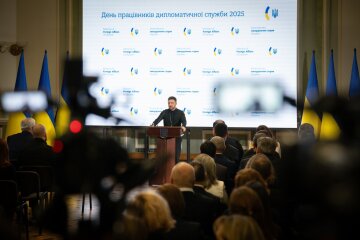
Ukrainian President Volodymyr Zelensky has made a series of landmark statements regarding NATO membership, a potential national referendum, the reconstruction of the Kakhovka Hydroelectric Power Plant, and the future of mobilization.
During a briefing with journalists, reported by Hvylya and other media outlets, Zelensky publicly presented a draft 20-point "framework" or "basic document" intended to end the war. This proposal involves Ukraine, the United States, Europe, and Russia. Critically, the final point of the draft stipulates that a total ceasefire will take effect immediately once all parties agree to the document.
National Referendum
Zelensky announced that Ukraine would submit the 20-point peace agreement to parliament for ratification or hold a nationwide referendum. He also suggested that national elections could be held simultaneously with such a vote.
"Ukraine will bring this agreement to parliament for ratification and/or hold an all-Ukrainian referendum for a 'yes' or 'no' approval," the President stated. He clarified that security guarantees would only take effect upon full ratification or popular approval. Zelensky noted that a referendum would require a minimum 60-day preparation period and a total ceasefire for that duration.
NATO Membership
The President addressed the agreement as a four-way pact between the US, Ukraine, Europe, and Russia, but emphasized that NATO membership remains a matter for the Alliance's member states.
Commenting on demands to drop Ukraine's NATO bid—which appeared in earlier drafts—Zelensky remained firm: "In our view, it is a choice for NATO members whether to have Ukraine or not. Our choice has been made." He added that Ukraine has not conceded to dropping its membership aspirations and has provided strong counter-arguments. "They [NATO and Russia] want to negotiate separately about the future... but that is an agreement between others, not ours," he stressed.
Kakhovka HPP and Energy Security
The draft agreement includes the restoration of the Kakhovka Reservoir, which is essential for cooling the Zaporizhzhia Nuclear Power Plant (ZNPP) and providing water to occupied Crimea.
"The Kakhovka dam and hydroelectric plant... could be rebuilt as a joint regional prosperity project," Zelensky said. However, he insisted that the ZNPP, the city of Enerhodar, and the Kakhovka plant must be fully demilitarized first. Zelensky estimated the construction cost at approximately 2 billion euros and suggested American involvement: "I believe the Americans could quickly build the dam... and water will be available everywhere."
Mobilization and Martial Law
If the peace agreement is signed and implemented, Zelensky stated that mobilization could be transformed or partially canceled. "Mobilization can be transformed or halted if there is an agreement being realized... or we could demobilize people partially," he said, adding that maintaining military positions remains the top priority during any transition. He also noted that martial law would likely remain in effect for several months after a signature, precluding immediate elections.
Security Guarantees
Point five of the document outlines that if Russia attacks Ukraine again after the agreement, the US and NATO members will provide security guarantees mirroring Article 5 of the North Atlantic Treaty.
-
Sub-point A: In the event of a re-invasion, all global sanctions against Russia would be reinstated alongside a coordinated military response.
-
Sub-point B: Guarantees would be voided if Ukraine invades Russia or opens fire without provocation.
-
Sub-point C: This point, reportedly drafted by US President Donald Trump, mentions "compensation" for the US in exchange for providing security guarantees. Zelensky noted that the definition of this compensation is currently unclear and the point has been temporarily struck out for further discussion.
-
Sub-point D: Covers bilateral security agreements with a "coalition of the willing" consisting of 30 countries, including Canada and Japan.
Zaporizhzhia Nuclear Power Plant
The ZNPP remains one of the most contentious issues. The US proposal suggests the plant be operated jointly by Ukraine, the US, and Russia. Zelensky explained that while Russia wants to link the plant's operation to humanitarian issues, Ukraine’s compromise position is a 50/50 joint venture between the US and Ukraine.
"50% of the electricity produced goes to Ukraine, and the US determines its own distribution for the other 50%," the President detailed. He concluded by noting that talks regarding the station have already exceeded 15 hours, highlighting the complexity of the issue.