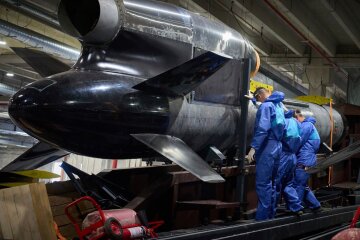
Defense company Fire Point, the manufacturer of the long-range Flamingo missiles, is capable of scaling production, but partners must place greater trust in young Ukrainian firms that currently possess the most relevant industry experience.
Iryna Terekh, Chief Technology Officer at Fire Point, shared this in a comment to Ukrinform.
"We can achieve anything as long as the funding is there. Most Ukrainian manufacturers have learned to design products from the outset that are ready for future scaling. This is crucial because there is an incredible number of excellent developments out there that simply cannot be mass-produced," Terekh said.
At the same time, the CTO acknowledged that the current level of bureaucracy within the European defense industry is so high that, in most cases, such cooperation is "less interesting than it is burdensome" for companies.
"To allow the Ukrainian defense industry to concentrate on what it does best—creating relevant weaponry that no one else in the world can produce—we need to remove the bureaucratic load. This can be done by simplifying processes and creating special models that facilitate this cooperation," Terekh stated.
She believes that partners need to move past their skepticism toward young Ukrainian companies and take the risk of collaborating with them.
"Today, many young Ukrainian companies have more relevant combat experience than some industry giants. They aren't in different leagues because one is better or worse, but because their experience differs. The experience of Ukrainian companies is the most relevant for today's warfare—not for the wars of the past, but for what is happening right now," Terekh emphasized.
Addressing criticism regarding the Flamingo missile's similarity to certain foreign designs, she explained that even in terms of intellectual property, a "know-how" must differ by at least 30% from a previous similar product to be registered.
"If you look at the defense industry today, you won't find many 'know-hows' in the traditional sense. The real innovation lies in the systems and approaches: the service systems, training, support, and the cycle of continuous innovation. This matters far more than the uniqueness of a single technical unit. So, of course, we drew inspiration from existing designs to shorten development time. But it’s not just about which navigation system we install; it’s about the fact that this system will always be updated to meet the most modern requirements," Iryna Terekh.