Ukraine’s Military Intelligence (HUR) has released detailed data on the production chain of Russian guided aerial bombs (KABs), which are used daily to target Ukrainian cities. Intelligence officials have made public information regarding 31 enterprises involved in manufacturing Universal Planning and Correction Modules (UMPC).
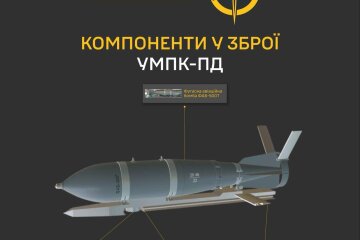
The report, published on the War&Sanctions portal, explains that these modules transform conventional Soviet-era "dumb" bombs (such as the FAB-250, FAB-500, and FAB-3000) into high-precision weaponry. Russian forces equip the bombs with folding wings, elevons, and specialized electronics. Navigation is facilitated by the "SMART" unit and the "Kometa" antenna, which is designed to resist electronic warfare.
A critical finding in the intelligence report is that several manufacturers of these lethal weapons continue to operate freely on global markets.
"Six enterprises from the published list are not currently under sanctions by any member of the sanctions coalition," HUR noted.
Among the companies evading restrictions are JSC "SKTB Kurganpribor," which assembles UMPC-250 and UMPC-500 modules, and CJSC "Gefest & T." The latter develops computing systems for Su-34 and Su-35S aircraft—the primary carriers of guided bombs.
"The absence of these companies from sanctions lists allows them to facilitate the unimpeded supply of goods and technologies from abroad and conduct financial operations through international banks," the agency warned.
The report also highlighted a mounting threat: in 2024, the Russian military began deploying extended-range UMPC-PD modules. These feature increased wing surface area and a more powerful "Kometa-M12" antenna, allowing Russian aircraft to release bombs from significantly greater distances.
In addition to the data on guided bombs, HUR updated its database with information on manufacturers of Kh-101 missiles, "Orion" drones, and the new "Molniya" (Lightning) UAVs.