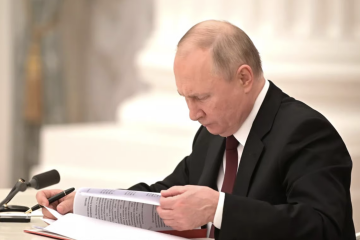
Vladimir Putin is running out of time to secure a peace deal for Ukraine as Russia faces a widening budget gap to fund the war. Kremlin envoy Kirill Dmitriev is scheduled to hold talks with US officials in Miami on Saturday, but anxiety is mounting in Moscow that this year’s spending will once again overshoot targets.
As Bloomberg reports, citing knowledgeable sources, the Kremlin is frantically seeking up to 1.2 trillion rubles ($16 billion) in new revenue streams to balance the books. This amounts to an additional 0.5% of GDP on top of the planned 1.6% deficit. The shortfall is attributed to plummeting energy revenues and an unexpectedly strong ruble.
Economic strain is deepening just as Russian and US representatives explore avenues to end the full-scale invasion. Yet, despite cautious optimism from American and Ukrainian officials, Putin shows no sign of abandoning his maximalist territorial demands in eastern Ukraine.
Speaking at a Senate hearing, US Secretary of State Marco Rubio stated that the territorial question remains the "single item" left to resolve.
"That is still a bridge we haven't crossed," Rubio noted.
Moscow, meanwhile, sees little chance of a breakthrough in peace talks. While military delegations are ironing out technical details of a potential ceasefire, territorial disputes require high-level political decisions. Putin wants Ukraine to cede control of the eastern Donbas (Donetsk and Luhansk regions) under the so-called "Anchorage Accords" reached at his August summit with Trump in Alaska. The proposal involves freezing hostilities along the current line of contact in the Kherson and Zaporizhzhia regions.
Alexander Gabuev, director of the Carnegie Russia Eurasia Center in Berlin, believes the US political calendar is also piling pressure on the Kremlin. President Donald Trump is increasingly focused on the midterm congressional elections in November.
"The terms Trump is proposing to end the war are the best Putin has seen in four years. It is unlikely these offers will remain on the table indefinitely. If Trump loses control of the Lower House, which is probable, it could throw a wrench in any of his initiatives," the expert explained.
Russia’s budgetary woes could worsen as US sanctions force oil producers to offer discounts on already cheap crude. The 2026 Russian budget assumes oil and gas revenues of 8.9 trillion rubles based on a Urals price of $59 per barrel and an exchange rate of 92.2 rubles to the dollar. However, Urals is currently trading at $55, and the ruble has strengthened to 75 against the dollar. If these trends persist, the revenue shortfall could reach nearly 2.2 trillion rubles.
Ukraine refuses to withdraw troops from fortified areas in eastern Donetsk unless Putin reciprocates with a mirror withdrawal. US proposals suggest turning the non-occupied zone into a demilitarized or free economic zone under special administration.
Regarding security guarantees, Rubio reported "general agreement." The plan involves deploying a limited contingent of European troops, primarily French and British, with US support.
"But effectively, the security guarantee is American support," the US Secretary of State emphasized.
Meanwhile, German Foreign Minister Johann Wadephul expressed pessimism regarding Moscow's stance. He criticized Russia's "stubborn insistence on the crucial territorial question."
"If there is no flexibility here, I fear negotiations could drag on for a long time or fail entirely," the German diplomat concluded.
It is also worth recalling why Putin agreed to an energy truce.