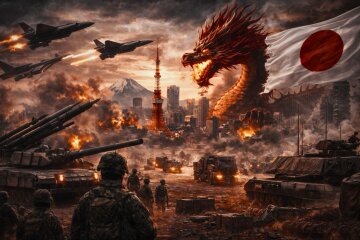
Japan has adopted an unprecedented military budget and is abandoning its orthodox pacifist policy for the first time in 80 years since the end of World War II.
Former Ukrainian Ambassador to Japan Serhiy Korsunskiy said this in an interview with Yuriy Romanenko.
The country reached the 2% of GDP defense spending level two years ahead of schedule and launched large-scale rearmament programs including new missile systems, submarines, multi-layered anti-drone defense, and naval fleet modernization.
"China made unimaginable mistakes. In particular, it inflated anti-Japanese propaganda to cosmic proportions, for which it paid the price. You saw before you a country that had pursued an orthodox peaceful policy for 80 years. You achieved that it abandoned this policy," the diplomat noted.
According to him, as soon as Takeichi became Prime Minister, Japan began working on serious strategic plans for multi-layered and echeloned defense, especially of air and sea frontiers. "A naval blockade of Japan would mean its strangulation. Therefore, combat operations must be conducted at a distance not of 200 kilometers from the coast, but a thousand," Korsunskiy explained.
The diplomat emphasized that over the past three months, rearmament has become the mainstream of Japanese politics, and that Prime Minister Takeichi enjoys the support of 92% of young Japanese – an unheard-of figure for Japanese politics.
"I've been in Japan for five years, the last three months I simply don't believe my eyes. Previously they talked about this quietly, calmly. Now this is the political mainstream," the ex-ambassador said.
Korsunskiy also noted that Japan has awakened traditions of producing excellent weapons, strategic planning, and meticulous organization of military affairs. "You have awakened two countries – Germany in Europe and Japan in Asia – which have very good traditions of producing excellent weapons. This has been in German genes for centuries, and they have essentially returned," the diplomat summarized.
Keywords: Japan, rearmament, pacifism, China, military budget, defense, Takeichi, militarization, security strategy, Pacific Ocean