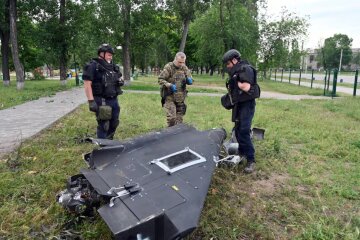
Russian occupation forces are implementing a new strike drone tactic by integrating them into a unified autonomous network using Chinese modems. This allows the enemy to control drones in real-time over vast distances and receive live video feeds during attacks.
Radio technology expert and military specialist Serhiy "Flash" (Serhiy Beskrestnov) revealed these developments during an interview on the Yuriy Romanenko channel.
Swarm Technology and Connection Resilience
According to the expert, Russian forces have begun equipping Shahed (Geran) and Gerbera drones with specialized Mesh modems. This technology enables drones to exchange data with one another, creating a chain of relays.
"It is a web. For example, 50 UAVs equipped with these modems flying over us create a large network across our territory. If we shoot one down, it’s no big deal; the network simply reconfigures itself," Serhiy "Flash" explained.
This system allows signals to travel across the entirety of Ukraine—from the Russian border to southern regions—providing the occupiers with a stable command channel that is difficult to suppress through localized jamming.
New Threats: Hunting Trains and Energy Strikes
By installing both standard and zoom cameras alongside stabilization systems (gimbals), Russian operators can now adjust a drone’s flight path during the final stage of an attack. This poses a critical threat to moving targets and infrastructure.
The expert emphasized that railway locomotives have become a priority target: "They are now actively using this to attack locomotives. When a Shahed approaches from behind, the locomotive has nowhere to go. A train cannot accelerate or evade. It is a guaranteed hit."
Furthermore, real-time control allows for more precise strikes on energy facilities. Previously, drones flew strictly by coordinates toward the center of a site; now, an operator can manually guide the drone toward the most vulnerable components, such as transformers.
Reconnaissance and the Threat to Air Defense
The new tactic also aims to detect and destroy Ukrainian air defense assets, particularly Mobile Fire Groups (MFGs). Gerbera reconnaissance drones can fly ahead of the main group to pinpoint the positions of sky defenders.
"The entire operational concept for Mobile Fire Groups has radically changed. They will have to use camouflage, carefully select positions, stay on the move, and protect their vehicles from strikes," the expert warned.
Serhiy "Flash" also noted that the Russians are installing rear- and upward-facing cameras to study the tactics of Ukrainian interceptor drones.
Scaling the Problem
Intelligence reports indicate that Russia is purchasing large batches of these modems from China, signaling intentions for mass deployment. Countering this is difficult, as the enemy can shift operating frequencies across a wide range (from 500 MHz to 6 GHz).
"Looking at this holistically, I am frankly concerned because this technology is highly dangerous and holds great potential," Serhiy "Flash" concluded, adding that Ukraine must develop similar solutions and enhance Electronic Warfare (EW) systems to cover the entire potential frequency spectrum.