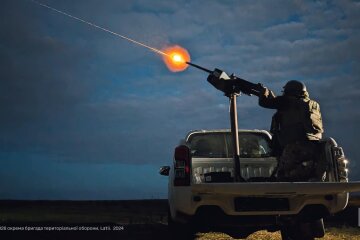
Ukraine's air defense system, particularly the work of its mobile fire groups, is currently demonstrating an efficiency that no other army in the world can replicate. Despite possessing modern weaponry, European nations would find themselves defenseless against the massive drone barrages Ukraine repels nightly.
Ukrainian military expert and radio technology specialist Serhii "Flash" Beskrestnov stated this in an interview with Yurii Romanenko.
Ukraine's Unique Experience
According to the expert, the effectiveness of Ukrainian defenders against Russian strike drones is akin to "science fiction" for Western military analysts.
"When our guys from the MFGs [mobile fire groups — ed.] shoot down, for example, 400-500 targets flying toward Kyiv and the region in a single night—no country in the world has such experience or capabilities. By and large, it is fantasy," Beskrestnov emphasized.
Europe Vulnerable to Mass Attacks
Serhii "Flash" recounted his conversations with European generals commanding air defense forces. They admit their defense systems are designed for entirely different scenarios and threat scales.
"If 1,000 targets suddenly flew into a country, it would be a disaster. Sure, they might shoot down 10, 20, 30, 40... Every small country like the Netherlands, Denmark, or Belgium has a certain number of air defense systems, but these systems are not designed to handle a thousand targets. It would simply be a collapse," the expert noted.
He stressed that Western air defense systems would quickly become overwhelmed, allowing the majority of drones to reach their targets and strike critical infrastructure. This is why the appearance of unidentified drones over European airfields and military bases causes such a stir and concern in the EU—it is an element of hybrid warfare and psychological pressure from the Russian Federation.
Russian Experiments and Alabuga
The expert also pointed out that Russia is actively involving youth in the war, specifically students from the Alabuga Polytechnic. Citing an investigation by the Molfar Group, Beskrestnov reported that Russians sent Alabuga employees to Turkey and Kazakhstan to test SIM card performance in roaming.
"They obtained information that the Russians sent 'Alabuga' employees to Turkey and Kazakhstan with SIM cards to conduct experiments on SIM card operation and data transmission across different countries with different networks," he explained.
In "Flash's" view, this indicates preparations to use drones equipped with LTE-based trackers in Europe, allowing for long-range UAV control.
Controlling Mobile Communications
Commenting on news about the Russian Ministry of Digital Development's plans to create an IMEI database and register all Russian mobile devices by 2026, Beskrestnov noted that the enemy fears a repetition of successful Ukrainian drone operations.
At the same time, the expert was skeptical about the feasibility of urgently implementing passport-based SIM card sales in Ukraine. He explained this citing the difficulty of administering a huge subscriber database and the presence of a vast number of technical SIM cards (in alarms, meters, cars) that are physically difficult to access for re-registration.