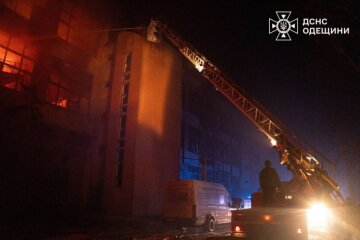
On the night of December 13, Russia launched one of its most massive attacks against the Odesa region. The strikes resulted in the loss of heat, water, and electricity.
This was reported by Oleh Kiper, head of the Regional Military Administration (RMA), Serhiy Lysak, head of the City Military Administration (CMA), and the State Emergency Service of Ukraine (SES).
Civilian facilities, energy infrastructure, and industrial sites were hit by the enemy attack.
According to the RMA, the attack sparked fires and damaged administrative buildings and energy facilities across the region. Rescuers are working to mitigate the consequences. Power supply interruptions are being reported in some areas.
Energy infrastructure facilities in the regional center (Odesa city) were also de-energized. Most of the city is without heating and water supply. All services are working to stabilize the situation.
Lysak noted that "Invincibility Points" are operational, and residents can also charge their gadgets at stores belonging to the retail chains "Tavriya-V," "Obzhora," "Tochka," "Kopiyka," and "Silpo."
He added that city hospitals have been switched to autonomous operation using alternative power sources. Water pump rooms (burets) are running on generators, and the delivery of non-potable (technical) water to various districts has been organized.
According to preliminary information from rescuers, four people were injured. The SES reported that, among other operations, they managed to extinguish a fire on a civilian vessel. More than 100 firefighters have been mobilized to deal with the aftermath.
The SES statement also mentioned that "fires broke out at energy infrastructure facilities and textile warehouses. Residential buildings, an administrative building, a civilian car, and a fire truck were damaged."
Specifically, the Izmail District State Administration (in the south of the Odesa region) announced that the air attack left settlements in the Vilkovska, Kiliyska, Katlabuzhska, and Safyanivska hromadas (communities), as well as part of Izmail city, without power.
Oleh Kiper, the head of the Odesa RMA, emphasized that the Odesa region is enduring one of the most massive aerial attacks.
Meanwhile, military-political observer Oleksandr Kovalenko stated that Russia might have used a Kh-47M2 Kinzhal hypersonic missile against the Odesa region for the first time.
"Odesa is tough... The last time we saw such an intensive missile threat was in 2023, during the grain terror campaign. That, incidentally, was when officials pledged to reinforce missile defenses in Odesa... Right, right. We remember, we remember, we remember..." Kovalenko continued. "Without exaggeration, this is the most massive raid on Odesa and the region since the start of the full-scale invasion. Furthermore, the complex problem of the region's vulnerability from the sea, which the enemy has regularly exploited—albeit on a smaller scale—and which has not been properly addressed despite numerous promises and announcements, has now fully manifested itself," the analyst stressed.
Train Delays
The Odesa Railway branch stated that train movements may be delayed due to the security situation in the Odesa region. A number of suburban trains will be temporarily suspended today, specifically:
-
No. 6253 Podilsk – Odesa-Holovna (Main);
-
No. 6255 Vapnyarka – Odesa-Holovna;
-
No. 6342/6341 Karolyno-Butaz – Odesa-Holovna.
Additionally, train No. 6403 Martynivska – Kolosivka operated on an altered route today (instead of Martynivska – Odesa-Holovna).
According to Lysak, the attack knocked out all of the city's traction substations, halting the operation of trams and trolleybuses. He noted that he has instructed bus carriers to increase the number of buses on city routes.
To ensure connectivity, special "social buses" have been organized:
-
Following the route of Tram No. 1: from the Railway Station to 28th Brigade Street (interval 30–40 min);
-
Following the route of Tram No. 5: from the Railway Station to Arcadia (via French Boulevard, interval about one hour);
-
Buses are operating along the routes of Trams No. 17, No. 18, and No. 20 with an interval of up to one hour.