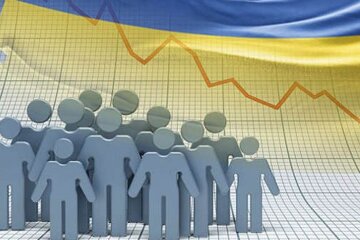
Ukraine is spiraling toward a demographic catastrophe: the country’s population has already shrunk from 42 million to under 36 million, and could plunge to just 25 million by 2051.
This assessment comes from a wide-ranging report by Reuters focused on the town of Hoshcha in the Rivne region.
According to the CIA World Factbook, Ukraine currently has the world’s highest mortality rate and lowest birth rate, with approximately three deaths for every birth. Life expectancy for men has plummeted from a pre-war 65.2 years to just 57.3 in 2024. For women, the figure has dropped from 74.4 to 70.9 years.
Hundreds of thousands have been killed or wounded over nearly four years of war, millions have fled abroad, and birth rates have nosedived. According to the Centre for Economic Strategy, about 5.2 million Ukrainians who fled after the invasion remain abroad. Between 1.7 and 2.7 million of them have no plans to return, and they could be joined by hundreds of thousands of adult men once the war ends.
Oleksandr Gladun, Deputy Director of the Institute of Demography at the National Academy of Sciences of Ukraine, notes that the crisis is exacerbated by the disproportionately high number of young women among refugees since 2022. UN forecasts suggest Ukraine's population could shrink to between 9 and 23 million by 2100.
The government's demographic strategy through 2040 warns of a labour shortage of 4.5 million workers over the next decade. Construction, the tech sector, and administrative services will face the most acute needs. The strategy envisions curbing emigration, encouraging the return of Ukrainians from abroad, and attracting immigrants. Under an optimistic scenario, the population could rise to 34 million by 2040; under a pessimistic one, it could fall to 29 million.
The town of Hoshcha, home to about 5,000 people, feels the full force of the demographic crisis despite being hundreds of kilometres from the front line. Only 139 babies have been born in the local maternity ward this year—down from 164 in 2024. Just over a decade ago, more than 400 children were born there annually.
"Many young men have died. Young men who, frankly speaking, were supposed to be replenishing Ukraine's gene pool," says gynaecologist Yevhen Hekkel.
Hoshcha and its district, with a population of around 24,000, have lost 141 people to the war since 2022. In the neighbouring village of Sadove, a school that once taught over 200 students has shut its doors. "Two years ago, we were forced to close the facility. Why? Because there were only nine children left," explains Mykola Panchuk, the head of the town council.
The maternity ward lost state funding in 2023 after failing to meet the threshold of 170 births per year. It now survives on local budget funds.
Marianna Khrypa, director of one of Hoshcha’s two schools, says the number of first-graders is falling, and about 10% of graduates—mostly boys—are moving abroad. "Parents are taking their children out of the country before they turn 18," she notes.
The uncertainty of the war has become a major deterrent for those considering starting a family. According to Inna Antonyuk, head of the maternity ward, about a third of the women visiting the department have husbands serving in the army; some have been killed or are missing in action.
"There is no stability, nothing to build on," says 21-year-old Anastasia Yushchuk. She adds that financial pressure caused by rising rents and the cost of living makes buying a home nearly impossible for young people.
Deputy Head of the Town Council Anastasia Tabekova’s husband is serving in the military. "A few days after I found out I was pregnant, my husband was mobilised. He was given leave for the birth. He left with tears in his eyes," she recalls.
Children can offer hope for the future, Tabekova says: "I know many wives whose husbands are fighting, and I know wives whose husbands, unfortunately, are no longer with us. They are holding on, some go to therapy, but for some, their children are a moment of joy, a reason not to give up."
Ukraine's demographic crisis was escalating long before the full-scale invasion. According to estimates by Ella Libanova, Director of the Institute of Demography at the National Academy of Sciences, Ukraine will never again have 50 or even 40 million citizens — unless there is intensive immigration. Deputy Director Oleksandr Gladun explains that to maintain a stable population, 100 women need to give birth to 210-220 children over their lifetimes; currently, that figure stands at just 92-98.
The situation with refugees adds to the pessimism: according to the Centre for Economic Strategy, only 43% of refugees worldwide plan to return — compared to 74% two years ago. Once martial law ends, over 500,000 fighting-age men, who are currently barred from leaving, may emigrate.
In response to these challenges, the Ministry of Social Policy, with support from the United Nations Population Fund, has developed a Demographic Development Strategy through 2040. It outlines measures to boost birth rates, tackle premature mortality, and ensure net migration growth.