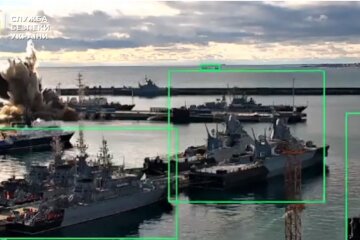
Overnight on December 15, Ukraine's Defense Forces carried out two large-scale operations against strategic enemy targets. In a historic first, underwater drones attacked a Russian submarine, while a key gas processing plant was also struck.
The Security Service of Ukraine (SBU) and the General Staff of the Armed Forces reported the strikes.
The SBU executed a unique special operation in the port of Novorossiysk. "Sub Sea Baby" underwater drones struck a Project 636.3 Varshavyanka-class submarine (NATO reporting name: Kilo). This marks the first recorded instance in history of a submarine being hit by underwater unmanned systems.
The explosion caused critical damage, effectively disabling the vessel. The submarine carried four launchers for Kalibr cruise missiles, which Russia uses to launch strikes against Ukraine.
The operation was a joint effort by the SBU's 13th Main Directorate of Military Counterintelligence and the Ukrainian Navy.
A Varshavyanka-class submarine costs approximately $400 million, though building a replacement under current sanctions could reach $500 million. This class is also known as the "Black Hole" due to its sound-absorbing hull, which makes it difficult for sonar to detect.
The targeted submarine had been forced to dock in Novorossiysk following successful operations by "Sea Baby" surface drones, which drove Russian warships out of Sevastopol Bay in occupied Crimea.
That same night, Defense Forces successfully struck the Astrakhan Gas Processing Plant, a critical facility in Russia's oil and gas sector. The plant produces up to 3.5 million tons of sulfur annually, a material used to manufacture explosives for Russia's military-industrial complex.
Explosions and a massive fire were reported at the facility. The full extent of the damage is currently being clarified.