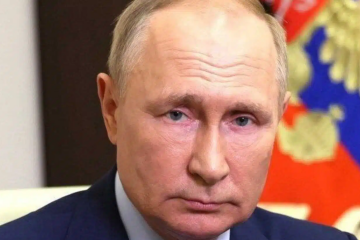
Vladimir Putin has preserved his grip on Russia by reviving a medieval conviction that injustice is never the tsar's fault but the work of his corrupt boyars, a new book by Times correspondent Marc Bennetts has argued.
As "Hvylya" reports, "The Economist" has reviewed Bennetts's "The Descent" and highlighted this monarchic template as one of the key mechanisms that keep the Russian president personally untouchable despite widespread corruption around him. Read the full review on The Economist website.
Bennetts illustrates the myth with the case of Alexander Shestun, a local administrator who refused to ban protests against a toxic landfill from which, residents believed, crooked officials were profiting. Summoned to Moscow, Shestun was warned by Kremlin figures to back down or lose his freedom and his home. He secretly recorded the meeting and posted it on YouTube, "naively imagining that this would get the corrupt bigwigs into trouble", the review writes. Instead he was jailed for 15 years and his house was confiscated.
The book argues that such outcomes do not dent Putin's personal standing because the propaganda apparatus routes blame downward to regional and federal officials while preserving the president as the final, fair arbiter. Bennetts writes that the Kremlin has deliberately constructed "the myth of an all-powerful decider" who alone can resolve serious disputes - a role that sheds responsibility when convenient and returns only when Putin wants to appear as a savior.
The effect, Bennetts says, is to strip ordinary Russians of any sense that they can influence events. A villager whose water had been poisoned by a nickel mine told environmentalists testing the water to "leave us in peace", shrugging that "we don't decide anything here - everything is resolved there, in Moscow". Previously, "Hvylya" wrote about how Moscow cheered the Alliance of Sahel States as a new client bloc, then failed to actually support it.