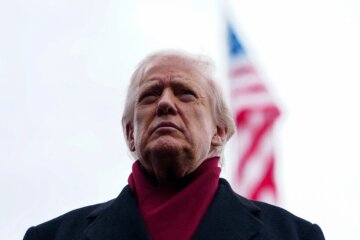
Donald Trump's return to the White House has exerted a significantly greater influence on European politics than the election of national leaders in those countries.
This conclusion was drawn by participants in a major international poll by POLITICO, as reported by Hvylya.
Independent London-based firm Public First conducted an online survey of over 10,000 respondents across the U.S., Canada, and Europe's three largest economies: Germany, France, and the UK. The research, carried out from December 5 to 9, aimed to determine Trump's specific influence on international affairs following his return to office this January.
Europeans Rate Trump Above Their Own Leaders
The results proved surprising: in both Germany and the UK, more than half of the polled citizens deemed Trump's election more significant for their countries than the selection of their own government heads. In Germany, 53% of citizens rated a Trump victory as more consequential for the country than the election of Chancellor Friedrich Merz, while just 25% prioritized the German elections.
The situation was similar in the UK: 54% of respondents stated that Trump's return proved more significant than the ascension of Keir Starmer and his Labour party, which ended 14 years of Conservative rule. Only 28% of Britons viewed the change in national government as the more important event.
French respondents were slightly more reserved in their assessment, yet 43% named a Trump victory as more significant than the election of Emmanuel Macron, who was supported by only 25% of respondents.
Canada was the only country where opinions were split nearly even. Mark Carney's April victory—with his promise to counter Trump—was seen by 40 percent as more significant than Trump's return to power. Nevertheless, a plurality of 45% still prioritized the importance of the U.S. election.
European Leaders Failed to Manage Trump
The survey results proved particularly unfavorable for German Chancellor Friedrich Merz and French President Emmanuel Macron. Their own constituents believe these leaders have largely failed in the task of effectively engaging with the unpredictable American President.
The leaders of the European Union look the worst. In France, only 11% of respondents believe that Brussels handled relations with Trump well, while 47% stated that the European leadership was poor at establishing relations with the White House.
British Prime Minister Keir Starmer received a somewhat better rating, with his work with Trump being considered neither good nor poor. In France, only 16% of citizens approved of Macron's handling of relations with Washington, while 39% rated his work as poor. In Germany, 24% approved of Merz's performance, and 34% assessed it negatively.
As for Starmer, 29% of Britons believe he is handling Trump well, while the same percentage reported poor performance. This is a rather weak result for a Prime Minister who has prioritized maintaining warm and effective relations with the American President.
Trump Deemed Stronger Than European Leaders
The research showed that Europeans generally share Trump's critical assessment regarding the weakness of their national leaders. Respondents view the American President as more "strong and decisive" compared to their own leaders: the ratio is 74% to 26% in Germany, 73% to 27% in France, and 69% to 31% in the UK.
Canada was once again the exception: 60% of Canadians named Carney as stronger and more decisive compared to Trump, with only 40% holding the opposite view.
However, the survey revealed an interesting nuance: the quality of being a "strong and decisive leader" is not considered the most desirable trait among voters. Honesty and transparency proved significantly more important in all five countries, including the U.S.
"Strength is not the most important trait for a leader, but it is clearly an area where the approach of European leaders fails to stand up to scrutiny, which is why Trump's words in his interview with POLITICO will ring true," noted Seb Reid, head of polling at Public First.
Europeans Want Confrontation, But Not from Their Leaders
The research uncovered an interesting paradox: Europeans generally want their leaders to confront and challenge Trump, rather than attempt to build friendly relations with him. However, when it comes to the specific actions of their national leaders, Europeans take the opposite stance, arguing that cooperation is more important than confrontation.
Canadians remained consistent in their approach: they favor Carney standing up to Trump.
"Perhaps the one opportunity Trump has offered national leaders is the opportunity to stand up to him, which, as we have found, generally improves attitudes towards them," Reid said. "By failing to meet that task, in the public's view, leaders have largely failed to respond over the past year."
Trump Changes the Rules of the Game in Europe
The poll was conducted at a particularly sensitive moment for transatlantic relations. The White House's new National Security Strategy, unveiled last week, shattered any notions of American neutrality toward its historical allies in Europe. Instead, the document launches a campaign to shift the region’s democracies toward its own MAGA ideology.
In an interview with POLITICO on Monday, Trump broadened this message, stating he would support party candidates in Europe who share his views—particularly regarding ending immigration.
"These results show how powerfully Trump has shaped the last year of political conversation, not just in the US but globally," Seb Reid observed. "That's true for the public and for politicians. The fact that so many people view the election of Trump on the other side of the world as more significant for their own country than the election of their own leaders demonstrates this graphically."
Moreover, POLITICO on Tuesday named Trump the most influential person shaping European policy, placing him at the top of its annual P28 list. This list is not an endorsement or an award; instead, it reflects each individual's ability to shape Europe's policy in the coming year.