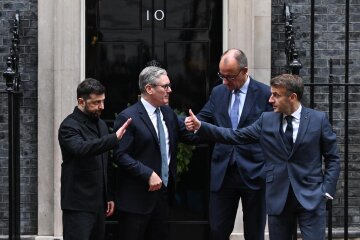
Leaders of the UK, France, Germany, and Ukraine convened in London on December 8 to discuss the US plan to end the war and security guarantees for Kyiv.
President Volodymyr Zelenskyy announced the meeting on social media, with confirmation coming from the Élysée Palace, writes Le Figaro.
According to Zelenskyy, the leaders discussed joint diplomatic efforts with the US in detail and coordinated a shared stance on the necessity of security guarantees, reconstruction, and future steps. "I am grateful to UK leader Keir Starmer, France's Emmanuel Macron, and Germany's Friedrich Merz for organizing this meeting and for their personal contributions on the path to peace," the President wrote.
The Élysée Palace noted that the meeting allowed for "continued joint work on the American plan" aimed at "supplementing it with European contributions in close coordination with Ukraine." This effort is currently "in the finalization stage," led by national security advisors ensuring alignment between the European, American, and Ukrainian sides.
"Work will deepen in parallel to provide Ukraine with robust security guarantees and outline measures for Ukraine's reconstruction," the Élysée Palace added.
Following the talks, German Chancellor Friedrich Merz assured that support for Ukraine "will not waver." "The fate of Ukraine is the fate of Europe. We are here to determine how to strengthen our efforts. Let no one doubt: our support will not waver," he wrote on X.
The four-way meeting lasted over two hours, followed by a discussion between Starmer and Zelenskyy for more than an hour. No press conference was held following the summit, and a joint statement has not yet been released. Zelenskyy subsequently departed for Brussels.
Meanwhile, Politico, citing a European official, reports that peace talks have stalled due to Ukraine's refusal to cede control of the Donetsk region to Russia. According to the source, US delegates are "insistent that Ukraine withdraw from the Donbas... one way or another." "On the territorial issue, the Americans have a simple approach: Russia demands Ukraine give up territory, and the Americans are thinking about how to achieve that," the source told the publication.
The London summit marks another stage in the intense diplomatic activity sparked by the Trump administration's unveiling of its 28-point peace plan. As analyst Yuriy Romanenko noted, this document was developed by US special envoy Steve Witkoff in consultation with Russian officials, without prior coordination with Ukraine or European partners—a situation reminiscent of Czechoslovakia in 1938. European officials were reportedly shocked at being left out of the loop, while the plan itself envisions significant concessions from Kyiv, including limits on the size of the Armed Forces and the de facto transfer of control over certain territories.
In response to the American proposals, Europe has prepared its own version of a peace initiative, which categorically rejects any restrictions on the Armed Forces of Ukraine or demands for territorial concessions. The European document insists on restoring Ukrainian control over the Zaporizhzhia Nuclear Power Plant and the Kakhovka Dam, proposing that territorial issues be addressed only after a ceasefire is in place.
Writing in a column for The Guardian, British historian Timothy Garton Ash observes that Ukraine's ability to survive both Russia's armed assault and Washington's diplomatic pressure now depends on Europe. He argues that if the EU provides sufficient military and economic support, the tide could turn against Putin in 2026–2027.