Ukrainian electoral officials have concluded that the country should not hold elections this year, setting Kyiv on a collision course with the United States.
Members of an official working group on elections, initially expected to present draft legislation to parliament late last month, told The Times they have yet to resolve critical questions regarding how to ensure a fair vote amid ongoing Russian attacks and interference.
The group plans to continue its deliberations until at least the end of May. However, a consensus has emerged that a campaign period should only begin six months after the necessary legislation is enacted and a ceasefire is established, effectively ruling out a presidential ballot in 2026.
"Everyone agrees, including members of parliament, that the active phase of hostilities must cease, a clear line of demarcation must be established, and only after that a six-month period is needed to organize elections," said Serhiy Dubovyk, deputy head of Ukraine's Central Election Commission. "The deadline has already been delayed. It is certain that it will be working throughout April and May because we have not yet worked through all the issues."
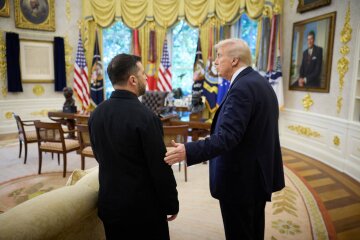
The decision defies pressure from U.S. President Donald Trump, who has demanded that Ukraine outline a plan for elections as part of any potential peace agreement with Russia. Moscow has also echoed these demands. At times, Trump has mirrored Kremlin narratives regarding President Volodymyr Zelensky's legitimacy, previously calling him "a dictator without elections" and arguing that Ukraine should hold a vote despite the ongoing war.
Zelensky and the current parliament have been in office since 2019. While elections were originally scheduled for 2024, Ukraine's constitution strictly prohibits holding parliamentary votes under martial law. Presidential elections could theoretically be held by amending the constitution via a referendum. However, the working group has ruled out voting during active hostilities, citing the severe risk of mass casualties if polling stations were targeted by Russian strikes. Furthermore, Dubovyk noted that martial law restrictions on freedom of speech and movement would severely hinder any political campaign.
Opposition parties have also firmly rejected the implementation of a digital voting system, expressing concerns over potential government manipulation and the inability to host international observation missions.
The working group—comprising electoral commission officials, lawmakers, and civil society representatives—was formed in December following pressure from Washington. Dubovyk described the logistical challenge as "unprecedented," noting the need to facilitate voting for approximately six million refugees abroad, three million Ukrainians living under Russian occupation, and nearly a million military personnel stationed at the front lines. The process must also strictly adhere to international standards to avoid jeopardizing Ukraine's European Union accession prospects.
"There is no precedent for holding a vote like this, certainly under the existing international standards, such as Council of Europe norms," Dubovyk explained. "There are no examples we can use as a basis."
Advisers from the Trump administration have controversially compared Ukraine's situation to the 1864 U.S. presidential election held during the American Civil War. Dubovyk expressed bewilderment at this comparison, pointing out the administration's failure to grasp modern threats such as airstrikes, cyberattacks, and digital information warfare.
"I will not name a surname, but do you know what example they cited to us? The Civil War in the United States," he said. "They said that during the Civil War we held elections, so why can't you? That came from the Trump administration."
Conversely, Dubovyk found British advice more applicable. U.K. officials suggested examining how Polish citizens cast ballots abroad, registering in advance and voting in community centers or schools rather than exclusively at embassies. However, this would require host nations to amend their own laws to permit foreign electoral processes on their soil outside of diplomatic missions.
"In the Czech Republic, for example, they have legal restrictions that the election process of another country can only take place on its consulate, not in the country," noted Tamila Tasheva, an MP from the opposition Holos Party who sits on the working group. "Now our Ministry of Foreign Affairs has to negotiate with such countries to persuade them to change their laws."
Tasheva highlighted that many MPs are eager to hold elections as soon as legally and practically possible, as the current parliament is facing a severe internal crisis. Since the full-scale invasion began, 54 MPs have resigned and 11 have died, with 28 of those losses coming from Zelensky's ruling Servant of the People party. Many remaining lawmakers are increasingly refusing to vote for government-sponsored bills.
"It's a real parliamentary crisis. The core of the majority they had even two months ago has collapsed," Tasheva said.
In response to his waning parliamentary support, Zelensky recently issued a stark warning to dissenting lawmakers. "Members of the parliament will have to either serve in parliament in accordance with Ukrainian law, or I am ready to discuss with representatives of parliament legislative changes to mobilization so that MPs can go to the front," the president threatened.
Recent polling data reflects the complex political landscape. According to a Kyiv International Institute of Sociology (KIIS) trust tracker for 2026, 62% of Ukrainians continue to trust President Zelensky, while 32% do not. Regarding the timing of national elections, a March 2026 poll found that 69% of respondents believe elections should only be held after a final peace agreement and a complete end to the war, while only 12% felt elections should be held immediately, even before a ceasefire.
When asked about voting intentions in a hypothetical presidential election, a late January to early February 2026 poll by Active Group showed Zelensky leading with 32.9%. He was followed by former Commander-in-Chief Valery Zaluzhny at 15.9%, military intelligence chief Kirill Budanov at 13.8%, and former President Petro Poroshenko at 10.9%.
The friction between the executive branch and the legislature highlights the broader strain of prolonged wartime governance. Olha Aivazovska, chair of the election watchdog Opora, criticized Zelensky for wielding his executive powers with little regard for parliament.
"When a president doesn't care about parliament during martial law, it's not good for the country, because parliament is the central power," Aivazovska warned. "His MPs are saying, 'We have a mandate here in this country, and there are issues we need to discuss.'"
Consequently, Zelensky is increasingly forced to seek consensus with opposition factions to pass critical legislation. Election laws will be particularly difficult to negotiate, Aivazovska added, as opposition parties remain deeply suspicious of any measures that might give the incumbent an unfair political advantage.