Ukraine faces a critical manpower shortage as the war enters its fourth year. Due to the lack of personnel, commanders are being forced to deploy young soldiers—who were previously shielded to ensure the country’s future recovery—to the front lines' most dangerous sectors.
According to "Hvylya," citing The Wall Street Journal, Ukraine is caught in a difficult dilemma: how to protect its future generation while providing enough boots on the ground to replace a professional army significantly depleted by years of combat.
Critical Mobilization Crisis
Most men willing to fight enlisted at the start of the invasion. Currently, infantry units are largely composed of older soldiers who struggle physically with demanding combat missions. Deployment terms on the front line have extended significantly, deepening personnel exhaustion. Meanwhile, many Ukrainians are either evading the draft or have illegally fled abroad through bribery.
Defense Minister Mykhailo Fedorov stated that approximately two million Ukrainians are avoiding conscription, while over 200,000 soldiers have deserted—roughly one-fifth of the total armed forces.
Rob Lee, an expert at the Foreign Policy Research Institute, emphasized: "Troop numbers are likely the most critical factor that will determine the course of the battlefield in 2026 and how much further Russia can advance."
Losses Among the Youth
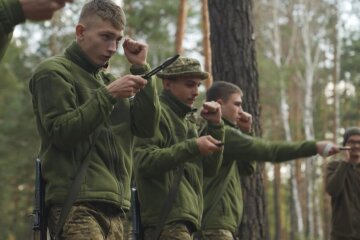
Over the past year, hundreds of young Ukrainians aged 18 to 24 joined a specialized program to bolster various brigades. Due to infantry shortages, commanders sent many directly into the epicenter of the Russian offensive. The consequences have been tragic, with many killed, wounded, or permanently disabled. Some have deserted.
Subsequently, the Ukrainian command allowed certain recruits in the 18-24 age bracket to serve their first six months in drone units, away from active combat.
The WSJ highlights the story of Kyrylo Gorbenko, who joined an accelerated training program immediately after turning 18, hoping front-line experience would help his application to a military academy. Less than six months later, Gorbenko was killed by Russian artillery fire near Pokrovsk. Because his body could not be evacuated, his family received neither state compensation nor official confirmation of his death.
"He just wasn't ready for war yet," his mother, Tetiana, said.
Father Mykola Kapralyk from Samara noted that he has lost about 100 parishioners to the war. He recently conducted a funeral for a 19-year-old soldier attended by hundreds. While Kapralyk praised the courage of young fighters, he expressed concern over their overconfidence: "They watched a few videos and believed they were invincible."