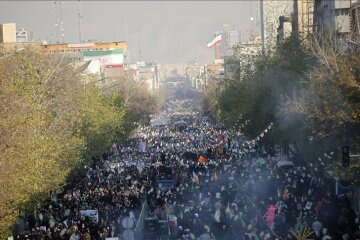
Reports have emerged today that since late 2025, protests in Iran may have already claimed 12,000 to 20,000 lives. Precise figures, as always, vary, but even the lower end of this range represents a catastrophe of national scale.
Iran's history has been through this before. In 1978–1979, the Shah's regime also climbed the escalation ladder. First came dispersals, then shooting, then "emergency measures," then confidence that fear would control the streets. The culmination was "Black Friday," when the army opened fire on demonstrators. After that, the regime was doomed—not because the protest grew stronger, but because violence drew in ever more people, because victims had relatives who joined new protests, which produced new victims.
It's important to understand: authoritarian regimes rarely fall from the first hundreds of casualties. They fall when the death toll becomes morally unbearable for the majority—for those who just yesterday were silent, wavering, or loyal. At some point fear stops working because the price of silence becomes higher than the price of protest.
The overthrow of the Shah in Iran in 1978-1979 cost anywhere from 3-4 thousand to moderate estimates of 10-15 thousand and 40-60 thousand in opposition sources.
If the figures of 12,000 to 20,000 deaths in current Iranian protests are close to reality, this means Iran has already passed that very point where repression doesn't stabilize the system but erodes its foundations. From here, two scenarios are possible: either sharp de-escalation or accelerated disintegration—with no middle ground.
Considering that Trump and his team are already going all-out in pushing support for the Iranian people, it appears the stakes will be raised. The mullahs are trying to break the people over their knee, but the disintegration of state institutions is clearly visible.
If we look at what's happening in Iran not emotionally but through the lens of macro-sociology, the picture becomes disturbingly familiar. Regimes don't fall because of a single protest. They collapse when several processes converge—and today in Iran they're converging simultaneously.
First—loss of legitimacy. The revolutionary narrative of 1979 no longer works for generations who didn't live under the Shah. Religious authority doesn't convert into trust, and anti-Western rhetoric explains neither poverty nor repression. The authorities increasingly justify themselves—always a bad sign.
Second—state overload. Sanctions, security spending, regional adventures, subsidies—the system spends more than it can reproduce. Administration substitutes for governance.
Third—escalation of violence. If data about 12,000 to 20,000 deaths is close to reality, this means passing the "point of moral rupture." Mass violence stops being an exception and becomes the regime's essence—and this almost always accelerates its delegitimization.
Fourth—demographics and expectations. A young, educated society without social mobility. The problem isn't poverty but the collapse of expectations—especially among the urban middle class.
Fifth—narrative collapse. Censorship and communication shutdowns are signs that the authorities are losing the battle for interpreting reality. Violence only compensates for this temporarily.
History teaches: at such points, a regime either sharply de-escalates or accelerates its own disintegration. Protest is the trigger. The causes lie deeper. Iran is now precisely where a system begins breaking down from within.